Sunday, June 2, 2013
Travel – May 29, 30 & 31 – Zurich, Switzerland
The weather and environment are very similar to Seattle’s. The city is surrounded by rolling hills that transition to high mountains; there is water all around and it rains. Sounds really familiar. It has been raining on and off since we arrived. Good thing we brought our umbrellas!
Monocle's 2012
"Quality of Life Survey" ranked Zurich first on a list of the top 25
cities in the world "to make a base within.” According to several surveys
from 2006 to 2008, Zurich was named the city with the best quality of life in the world as well as the wealthiest city in
Europe.Many museums and art galleries can be found
in the city, including the Swiss National Museum and
the Kunsthaus. Zurich
also hosts one of the most important theatres in the German-speaking world.
Saturday, June 1, 2013
May 28 – Tuesday – Train from Venice to Zurich, Switzerland
Our entire
day was spent on the train from Venice, Italy to Zurich, Switzerland. It is not a problem for us because we LOVE to
ride trains. We awoke early and had
breakfast at the hotel. This is with a
sigh of relief. As I said things are
expensive here, our modest dinner last night was $150 dollars and that did not
include any wine. (OK… John had an Italian beer.) Yes, we are still recovering from being
spoiled.
| Grande Canal in front of train station |
We had fun
pulling our suitcases over a very large bridge.
This one had big stairs. It
crossed the Grande Canal. On a normal
morning or evening on the canal the boats, ferries and utility boats roar by so
fast you would think it was the Los Angeles freeway. The only trick is that there don’t seem to be
any traffic rules. It is like watching
bumper boats. It is great fun. Between watching the boats and the people,
John and I could spend all day just sitting in one spot being completely
entertained. What a great sport!
Anyway, back to pulling the luggage. The lift up was challenging but we both made it. We took it in little chunks and things went fine. The way down seemed easier, at least I thought so. But, I had about five people stop and ask me if I needed any help, yet I was the one with the lighter load. I guess I looked like one little old decrepit lady about to pass out. Robust John was doing just fine. I kept on telling people that I was fine; I wanted to say that I’d carried my bags over the Grand Canal in Venice. I’m sure most people thought I was crazy, but then that wouldn't be the first time.
The train
station was busy. Luckily, we had
checked everything out the day before.
We knew where to register our tickets.
John had purchased them on-line at home before we left on our trip. He should have been a travel agent. His planning worked like clockwork as
usual. Our first train took us to
Milano, Italy. We had about an hour and
a half layover before catching our train to Zurich; lunch was a Burger
King. After ordering two number one
meals, we were about thirty dollars poorer.
This may give you a reasonable bench mark on the cost of things here.
| Milano, Italy train station. Largest in Italy |
From Milano, we caught the train to Zurich. The train ride took about four hours. We were lucky to get nice seats with good viewing windows. The hills were green in northern Italy, and eventually we found ourselves in the valleys and hills of the Italian Alps. We began to climb the mountains, and very soon Italy became Switzerland. We went through at least twenty tunnels before we arrived in Zurich. One or two of the tunnels were about three miles long.
| Lake Zurich with Alps in the background |
The Swiss
country side is beautiful. Things look
so clean and neat. Everything is so very
organized and orderly. This feels so
different from my experience in Italy, where things are crowded, haphazard and
seemingly unplanned, and in very many places in a significant state of decay. In Switzerland, everything seemingly works, runs
on time, rings on time, opens and closes on time. I love it!!!
We arrived
in Zurich to find it rainy and cool. For
a moment, I thought we were home! We ran
between rain drops to a cab. We found
the most off beat cab driver I’ve ever had; he kept raving about tax laws, various
countries, politics and companies that are not paying US taxes. I guess the US is having some impact here –
at least on wide-eyed and emotionally on-edge cabbies. By the end of the trip, at least he had
successfully driven us to the hotel and made sure we knew where the Swiss
museum was. It was an interesting
introduction.
| View from our room |
Our hotel,
Helmhaus Hotel at Schifflande 30, am Limmatqual, in Zurich is wonderful. It is right on the edge of the old town and
Lake Zurich, and within walking distance of almost everything. We have a lot of exploring to do. We will tell you more about that
tomorrow. It’s been a long day. Stay tuned for more of the adventure. Sleep tight!
Friday, May 31, 2013
May 26 – Sunday – Venice, Italy
May 27 –
Monday – Venice, Italy
AHHHhhhhhh, here we
are at the end our cruise, and our beautiful home at sea is gone. What a lovely time we had. We were rocked to sleep at night and fed all
the food we could eat and more. We were
entertained when we wanted to be, quiet when we wanted to be alone and met some
new friends. I would recommend this type
of travel to anyone who likes to relax and has hobbies like reading and
resting, or those who like running around from town to town when there are
ports-of-call. It can be restful or tiring,
your choice. I like the days at sea
best.

Well, here we are
in Venice. Our first day, while still on
the ship was spent checking out our future hotel and the train station. We were going to walk our suitcases from the
ship to the hotel and wanted to be sure how far this would be. It looked pretty easy on the map. Of course the map looks pretty flat. Venice has hundreds of little bridges, with
many little and sometimes big steps.
Venice (Italian: Venezia [veˈnɛttsja] Venetian: Venexia [veˈnɛsja]; (Latin: Venetia)) is a city in northeastern Italy sited on a group of 118 small islands separated by canals and linked by bridges. It is located in the marshyVenetian Lagoon, which stretches along the shoreline between the mouths of the Po and the Piave Rivers. Venice is renowned for the beauty of its setting, its architecture and its artworks. The city in its entirety is listed as a World Heritage Site, along with its lagoon.
Venice is the capital of the Veneto region. In 2009, there were 270,098 people residing in Venice's
comune (the population estimate of 272,000 inhabitants includes the population
of the whole Comune of Venezia; around
60,000 in the historic city of Venice (Centro storico); 176,000
in Terraferma (the Mainland), mostly in the
large frazioni of Mestre and Marghera; 31,000 live on other islands in the lagoon). Together
with Padua and Treviso, the city is included in the Padua-Treviso-Venice
Metropolitan Area (PATREVE), with a total population of 1,600,000. PATREVE is only
a statistical metropolitan area without any degree of autonomy.
The name is derived from the ancient Veneti people who inhabited the region by the 10th century
BC. The city historically was the capital of the Venetian
Republic. Venice has been known as the "La
Dominante", "Serenissima", "Queen of the Adriatic", "City of Water", "City of
Masks", "City of Bridges", "The Floating City", and
"City of Canals.
![]() |
| Students waiting for their school water bus |
The Republic of Venice was a major maritime power during the Middle Ages and Renaissance, and a staging area for the Crusades and the Battle of Lepanto, as well as a very important center of commerce (especially silk, grain, and spice) and art in the 13th century up to the end of the 17th century. This made Venice a wealthy city throughout most of its history. It is also known for its several important artistic movements, especially the Renaissance period. Venice has played an important role in the history of symphonic and operatic music, and it is the birthplace of Antonio Vivaldi.
John was already dragging the big ones down the other side. It took us under an hour, but we saved about $150 Euros by not hiring a water taxi for a fifteen minute ride. We are slowly working off the ship calories! We are also coming to the reality that we are not in ‘Shipville’ any longer. Everything here is expensive!
After saying
farewell to the ship and getting our luggage to the hotel we finally got to
explore the city. The desk clerk advised
that there was a free shuttle to the Murino Glass Factory. We decided to hop on that first. We got to watch them blow some beautiful
glass and then see the show room. Sorry
no pictures as everything is proprietary.
We then hopped
another water taxi to Saint Marks Square to take in all the must see
sights. Unfortunately, everyone else
thought it was a must-see, too. It was
so crowded we could hardly move. As we
stood on the walk bordering the water, a complete wedding party passed right in
front of us. I’ve got a movie of
this. Unbelievable to see so many people
in one spot. The lines to get into the
buildings in the area were so long that it would take at least three to four
hours just to reach the door. John and I
decided that life is too short. Both he
and I had been there before; thus, we walked on.
We loved our walk
wandering back to our hotel. John had
the map and navigated. Sometimes we were
not quite sure where we were going, but my navigator saved the day, and we
arrived safely back at the hotel just in time for dinner. Oh….did I mention that during our wandering
we stopped for pizza at a little shop and ate it on a step of one of those many
bridges I told you about?
The hotel desk
directed us to a restaurant that fed Americans before the rest of the Europeans
ate (i.e. about 6 o’clock). We had the
best Ravioli stuffed with cheese and spinach I have ever eaten. The antipasti was also wonderful. I could tell you where the restaurant is, but
not the name. I think that you might
find a number of good Italian pasta restaurants around the Venice train station
from what I saw. There is also a lot of
good souvenir shopping. I loved looking
at the glass beads and the masquerade masks.

Tomorrow we are headed to
the train station, and it’s off to Zurich.
I have one more towel animal for you.
Sleep tight and I’ll see you in Zurich.
Travel - May
25 – Saturday – Dubrovnik, Croatia

The evening before
we arrived in Dubrovnik we were treated to two interesting views from our stateroom
veranda. Just before going to bed we saw
a beautiful full moon arise over the Croatian coast line. We later had a terrible thunder storm during the
night. Early the next morning we look
out to see a fellow cruise liner pacing us with all of its lights on. It was quite a site in a pre-dawn sky. I was lucky enough to get a picture of both
the moon and the ship. I thought I’d
share both with you.
Dubrovnik is a UNESCO site and you can tell it the minute you get off the bus. Yes, it looks almost like I remembered it, but with a lot more people. The ship docked between the cruise ship port and the industrial part of the city. The old fort city is about three to four miles around the sea shore from the port. We again took a shuttle bus to the old town. It is a beautiful, old, well-kept town of history.
Dubrovnik (pronounced [dǔbroːʋnik], Italian: Ragusa, Greek: Ραγκούσα, Ragoùsa) is a city on the Adriatic
Sea coast of Croatia, positioned at the terminal end of the Isthmus of Dubrovnik. It is one
of the most prominent tourist destinations on the
Adriatic, a seaport the center of Dubrovnik-Neretva county. Its total population is 42,641 (census 2011). In
1979, the city of Dubrovnik joined the UNESCO list of World Heritage Sites.
The prosperity of the city of Dubrovnik has
long been based on maritime trade. In
the Middle Ages, as
the Republic of Ragusa, also known
as a Maritime Republic (together
with Amalfi, Pisa, Genoa, Venice and other Italian
cities), it became the only eastern Adriatic city-state to rival Venice. Supported by its wealth and
skilled diplomacy, the city
achieved a high level of development, particularly during the 15th and 16th
centuries.
The beginning of tourism in Dubrovnik is
often associated with the construction of the late 19th-century luxury hotels
in Croatia, such as Grand Hotel (1890) in Opatija and the Hotel Imperial (1897) in
Dubrovnik According to CNNGo, Dubrovnik is among the 10 best medieval walled cities in
the world.

Although Dubrovnik was demilitarized in the
1970s to protect it from war, in 1991, after the breakup of Yugoslavia, it
was besieged by Serb-Montenegrin forces for seven months and received significant shelling
damage. When you look at the walls of the fort you can tell where the damage occurred. Not from the holes in the wall, but in the
areas that have been newly repaired.
There were tourists
from everywhere. If you turned in a
circle you could hear at least eight languages being spoken. There were many Croatian bands and folk
singers both inside and outside of the fort walls. You could tell that they were very proud of
their country and history. There was a singing
group willing to pose for as many tourists that could crowd in during a five
minute period. They could have stood
there all day and the cameras would have continued to click.
The walls of the
fort in some place were so thick that people lived, or they had shops in the
base of the walls. The center of the
city area was flat, but many of the side streets had stairs going almost strait
up, at least it looked that way. We
never quite made it all the way to the top of the fort wall, but I did see out
a small door on the side and the view was breath taking. It was like being at the top of at least a
ten story building that dropped perilously to the sea. The sea was so clear you could see every
rock.
Just like all little towns, residents of this beautiful place have a small market in their plaza areas. Dubrovnik’s market had lavender sachet, dried fruit, olive oil and other wonderful items from their local region. Oh…if only there was not a fifty pound weight limit on the airline luggage requirement. I was already at the limit when I left. VERY SAD!!!
Well, it’s time to say farewell to Dubrovnik and go on to our final cruise port, Venice. It is hard to believe that the cruise is almost over. The time has gone by so quickly. We do have one night on the boat in Venice so we can slowly break into the idea of being without our ship.
Next report will probably
be from our hotel in Venice, or from Zurich.
Hang on, we are not finished yet!!
(However, the towel animals are almost at an end.)
Wednesday, May 29, 2013
Travel - May 24, 2013 - Kerkira, Corfu, Greece
It has been at
least thirty years since I last visited Corfu.
I remember walking through an old town on very steep streets with many
little shops with olive wood items and other Greek souvenirs. The town of Kerkira is quite large for a
small island “village” and fairly modern.
John and I elected not to take a
formal tour, but did decide to take the shuttle provided by the ship to the
largest castle/fort at the end of the city.
I’d never seen it before and the view was fantastic. Actually from the ship the whole city looked
like a series of castles connected by walls.
Some call this area the city of castles.
It really is a beautiful place with a lot of history.
Corfu (Greek: Κέρκυρα, Kérkyra, [ˈcercira]; Ancient Greek: Κέρκυρα or Κόρκυρα; Latin: Corcyra; Italian: Corfù) is a Greek island in the Ionian Sea. It is the second largest of the Ionian Islands, and, including its small satellite islands, forms the edge of the northwestern frontier of Greece. The island is part of the Corfu regional unit, and is administered as a single municipality. The municipality includes the island Corfu and the smaller islands Ereikoussa, Mathraki and Othonoi. The principal city of the island and seat of the municipality (pop. 32,095) is also named Corfu. Corfu is home to the Ionian University.

The island's history is laden with battles
and conquests. The legacy of these struggles is visible in the form of castles
punctuating strategic locations across the island. Two of these castles enclose
its capital, which is the only city in Greece to be surrounded in such a way.
As a result, Corfu's capital has been officially declared a Kastropolis ("castle
city") by the Greek government. Corfu was long controlled by Venice, which repulsed several Turkish sieges, before falling under British rule following the Napoleonic
Wars. Corfu was eventually ceded by the British
Empire along with the remaining islands of the United States of the
Ionian Islands, and unification with modern
Greece was concluded in 1864 under the Treaty of London.
In 2007, the city's old city was designated for the UNESCO World Heritage List, following a recommendation by ICOMOS.
Corfu is a very popular tourist destination. Up until the early 20th century, it was mainly visited by the European royals and elites, including Emperor Wilhelm II of Germany and Empress Elisabeth of Austria; today it is also widely visited by middle class families (primarily from the UK, Scandinavia and Germany), leading to mass tourism. It is still popular with the global elite however, and in the island's northeast the homeowners include members of the Rothschild family and Russian oligarchs.
Most of our activities involved walking
around this beautiful hill area looking at shops and taking pictures. I’ve provided a number of them for you to
view here. It is very evident looking at
the conditions of the buildings and residence that the economy is having
problems. As John says, there is not
enough money in the world to fix the areas we have visited. So many old building needing so much
repair. None of the governments have the
resources to keep up these beautiful monuments.
A few of the things I am enjoying taking pictures of are windows, doors, floors and walls. It is amazing how different these are between countries. It is also fun to look at the designs and compare them. I’ll be busy once I get all my pictures home. I've taken over a thousand. I’m in heaven!!!
One more stop before Venice and that is Dubrovnik. I can’t wait, I want to see what differences there are now that it is a new country. Last time I visited it was in Yugoslavia. Stay tuned…yes….there is more to come.
Sunday, May 26, 2013
Travel - May 23 – Thursday – Katakolon, Greece Before the cruise John and I decided we would stay on board at Katakolon and do laundry. When we arrived on board we discovered that there were no “do it yourself” laundry facilities and everything had to be done by the ships laundry. That freed us up for the day. We had seen Ancient Olympia and were not really interested in another long bus ride. The small town of Katakolon beckoned.
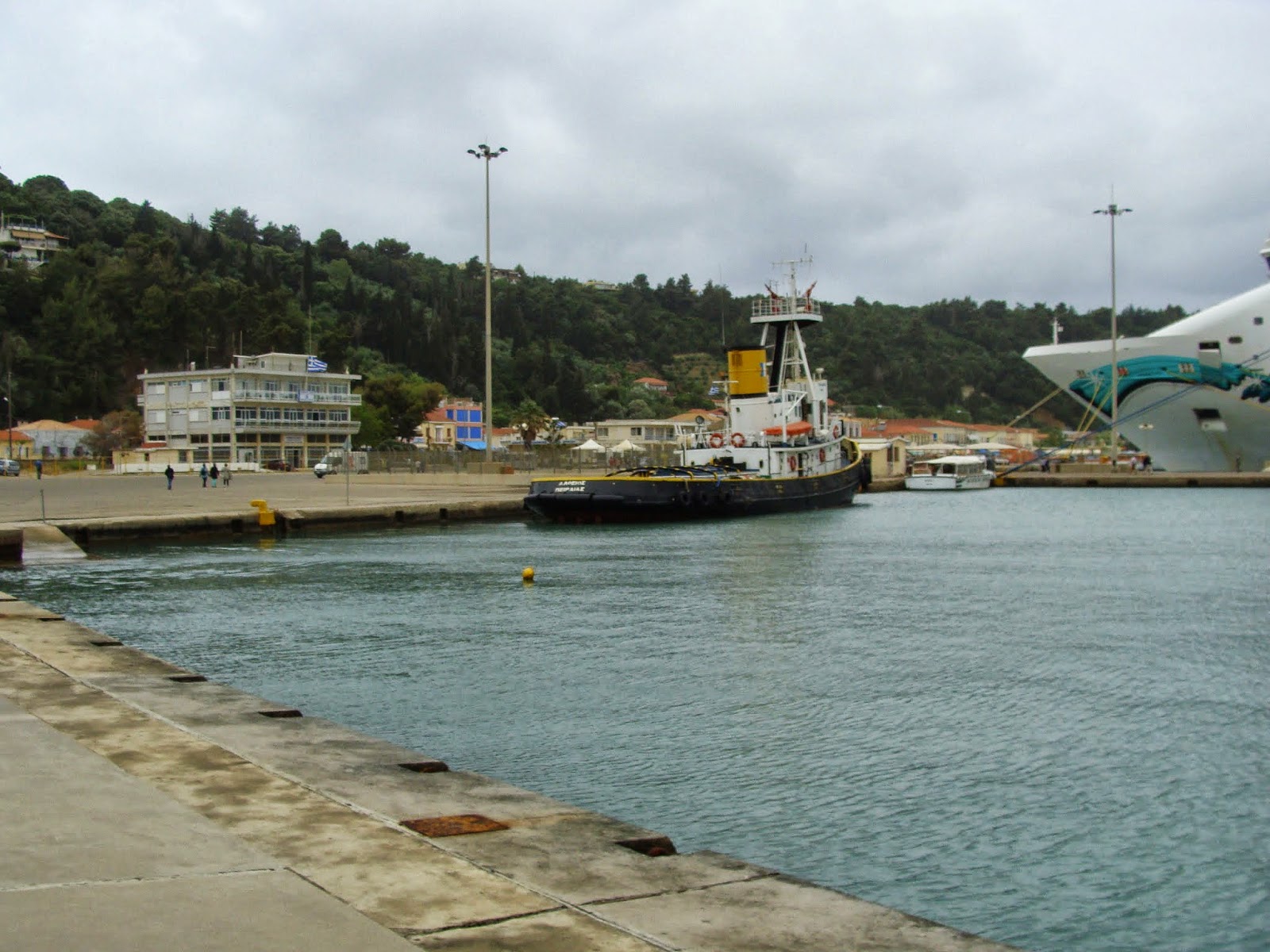
Katakolo (Greek: Κατάκολο) is a seaside town in the municipality of Pyrgos in western Elis, Greece. It is situated on a headland overlooking the Ionian Sea and separating the Gulf of Kyparissia from the rest of the Ionian. It is 11 km west of downtown Pyrgos. The small village of Agios Andreas lies northwest of Katakolo. A railway connects Katakolo with Pyrgos and Olympia, but along with the rest of the rail network in the Peloponnese, services have been suspended since 2011 for economic reasons.
The port of Katakolo is a popular stop
for cruise ships, offering
an opportunity for passengers to visit the site of Ancient
Olympia. Low hills with forests surround Katakolo.
The lighthouse of Katakolo was built in 1865.
Going out on a trek always allows for new
photos and the possibilities of finding interesting materials to work
with. Katakolon is a port town, in
modern times prepared to entertain the tourists. As we walked along the long break water wall
we took many pictures of the port. Once
we arrived in the dock area it was all for the tourists. Any type of transportation you might want was
available, from horse drawn cart to modern tour bus and…taxies galore. All indicating they would take you to see the
sights, from Olympia to a tour of the local villas.
John and I elected to walk the streets of
this small port tourist town. It seemed
as though most of the shops were selling jewelry. The wares ranged from the standard Chinese
made fair to the very expensive gold and silver jewelry shipped in from the
Middle East and elsewhere. It is sad
that each place we visit has more of the same to offer and less unique to their
special area. So many things are made in
China.
We did find one shop that delighted us. On prior visits to this part of the world I
remember seeing stores full of items made with olive wood. We stumbled across one in Katakolon. It is the only one we have seen. While

talking to the shop owner she said that
she and her husband decided they would open a shop that wasn’t based on Chinese
goods. We applauded them for their
effort. The shop had beautiful olive
wood beads and I had a large bag of them before we left. We found another gem amoungst the clutter.
If you are ever visiting Katakolon, I’d
highly recommend that you stop by Aristoteles Olivewood workshop If you are interested in taking
a look at their shop you can find them on Facebook.
We are on our way to Corfu, Greece. This is one of my favorite places. I’m looking forward to a new adventure in Corfu. Stay tuned…there is much more to come.
Subscribe to:
Posts (Atom)